Bollington Online War Memorial
A project supported by the parish of Bollington
Canadian and Australian Regiments in WW1
"Overseas" Soldiers
Some people have wondered why we have some war graves at Bollington for soldiers who served with Canadian or Australian regiments.
These graves are of local men who had emigrated and died while on leave in Britain.
You can read about some of the families who emigrated here: Barlow, Biddulph, Bradbury, Brown, Davenport, Fleet, Gibson, Grounds, Heys, Long, Mayers, Ridgway, Schofield, Shires, Tinsley, Trueman, Vickers, Wainwright, Wright, Wrigley.
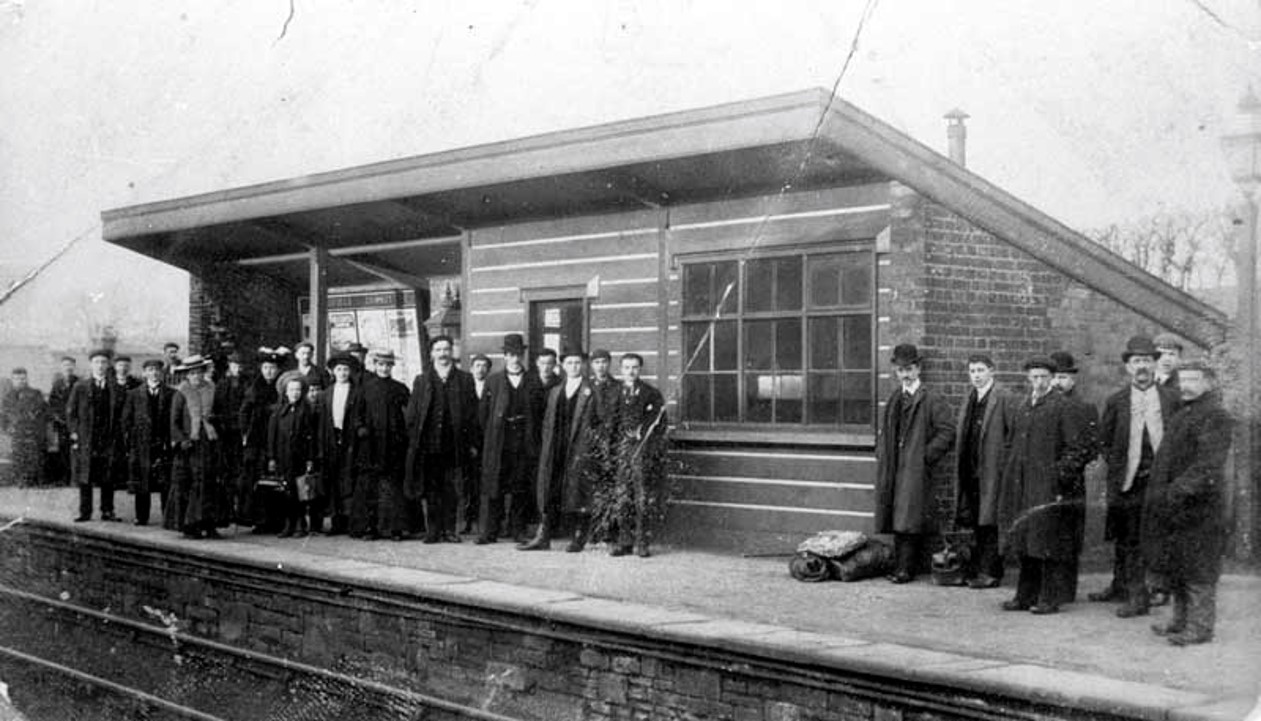
Emigrants waiting at Bollington Station 1909
1900-1914 was a period of change and uncertainty in Bollington. There were strikes at the mills for better wages. The hot summer of 1911 caused a shortage of water that the mills relied on to keep the steam operated equipment running. There was a coal strike in 1912. Some of mills closed for a time because of bankruptcies.
At the same time there were opportunities for people to start a new life in Canada, USA and Australia.
About 1.5 million people emigrated from Britain to Canada in the years 1903-1913. This represented nearly 50% of all emigration during this period.
A significant number of Bollingtonians took the decision to emigrate.
And then came WW1. Young men who had emigrated found themselves back in Europe as soldiers a few short years later.
In the days when travel between continents required long sea journeys, these men could not return home on leave, but they were allowed furloughs to Britain, where many still had family members.
And some of these men died of sickness or wounds in UK and were buried at Bollington.