Bollington Online War Memorial
A project supported by the parish of Bollington
The Cheshire Regiment in WW1
Of the thousand or so men associated with Bollington who served in WW1, over three hundred served with the Cheshire Regiment for some or all of their military service. Over 120 served with the 7th Battalion of the Cheshires.
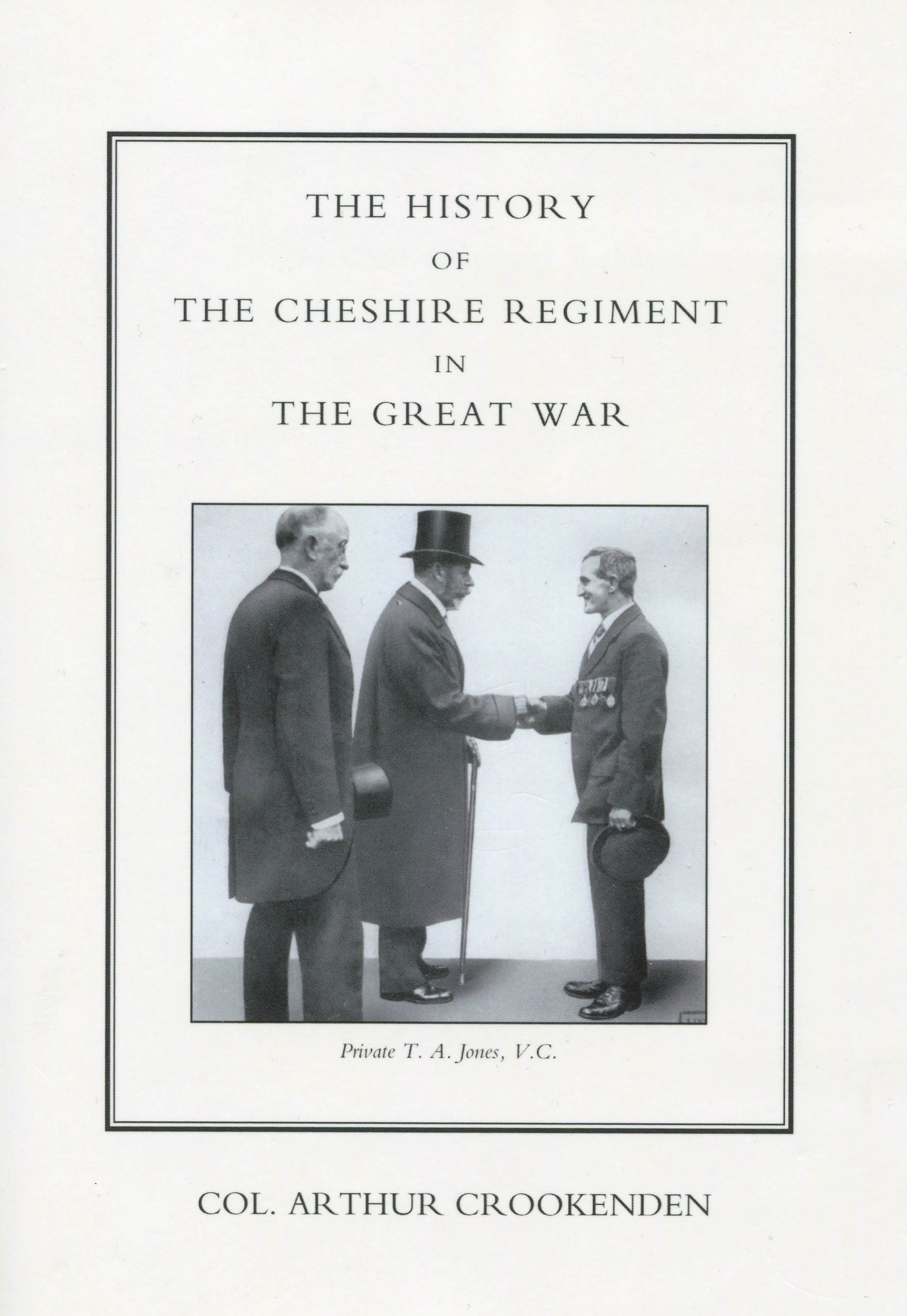
"The History of The Cheshire Regiment in The Great War" by Col Arthur Crookenden provides details of, and commentary on, the named battles with which the Regiment is associated.
Immediately before WW1, there were three battalions of the Cheshire Regiment in the Regular Army and four battalions of Territorials.
Regular Army
The 1st Battalion was in Londonderry in August 1914. Early on the morning of 14 August 1914 the battalion travelled in two special trains to Belfast, and boarded the SS Massillia.The ship sailed under sealed orders which, when opened, revealed the destination to be France.
The 2nd Battalion was in Jubbulpore, India in August 1914. It returned to England, landing at Devonport on 24 December 1914 and went into camp near Winchester. It travelled by road to Southampton on 16 January 1915 and embarked on SS City of Chester, landing at Le Havre 17 January 1915.
The 3rd Battalion was a training unit and remained in UK throughout the war, providing drafts for other battalions, although it also took part in Mersey Defences at Birkenhead, for example.
Territoral Force
The 4th, 5th, 6th and 7th Battalions formed the Cheshire Infantry Brigade, part of the Welsh Division.
The 4th Battalion was in Birkenhead in August 1914 and sailed in July 1915 from Devonport, going via Alexandria to Gallipoli where it landed on 9 August 1915.
The 5th (Earl of Chester’s) Battalion was in Chester in August 1914. In 15 February 1915 it landed at Le Havre.
The 6th Battalion was in Stockport in August 1914. It landed in France 10 November 1914.
The 7th Battalion was in Macclesfield in August 1914. The battalion sailed in July 1915 from Devonport, going via Alexandria to Gallipoli where it landed on 9 August 1915.
Following the declaration of war, a number of additional battalions were created. Some were part of the Regular army (Kitchener's New Army).
The 8th Bn sailed for Gallipoli in July 1915.
The 9th arrived at Boulogne 19 July 1915.
The 10th and 11th landed in France 26 September 1915.
The 12th landed at Boulogne 6 September 1915, but moved to Salonika by November 1915.
The 13th landed at France 25 September 1915.
All these were service battalions.
The 14th and 17th were training and reserve battalions.
The 15th and 16th were the "Birkenhead Bantams", men who did not come up to the required standard in height and would not, in peacetime, have been accepted. They landed at Le Havre in January 1916.
18th, 19th, 20th, 21st and 22nd Battalions were formed as Labour Battalions in 1916, later becoming part of the Labour Corps.
23rd Battalion was originally a "Home Service" battalion but went to Calais in Spring 1918, initially as a Garrison Guard battalion.
24th (Home Service) Bn was formed on 27 April 1918 to replace the 23rd Bn.
1st Garrison Battalion was formed at Chester on 1 August 1915, then went to Gibraltar where it remained throughout the war.
2nd Garrison Battalion Cheshire Regiment was formed at Bebington in October 1915, then went to Egypt and Palestine where it worked on Lines of Communication.
3rd (Home Service) Garrison Battalion was formed November 1915 and moved to Ramsay, Isle of Man. Later it converted into 11th Bn, the Royal Defence Corps.
Additional Territorial Battalions were created for training and home service only; the original battalions being given the prefix "1/". The additional battalions were 2/4th, 2/4th, 2/5th, and so on.
51st, 52nd and 53rd Battalions were part of the Training Reserve.
A total of 38 battalions were raised, of which 15 served in engagements with the enemy.
When war was declared, all current Territorials were embodied into the Regular Army, along with reservists from the Regular Army. From then on, all new recruits joined the Territorials or other Training battalions, such as 3rd Cheshires. Once trained, they could be posted to service battalions as required. Men who had been sick or wounded might be posted to a reserve/training battalion until they were fit enough to return to service overseas.
Initially, new recruits usually had 4-digit regimental numbers, but in 1917 it became evident that larger regimental numbers would be needed and all currently serving soldiers in the Cheshires were allocated new 6-digit numbers. Soldiers who had died or been discharged or had been taken as prisoners of war did not get new numbers. 1/7th Battalion, being based at Macclesfield, was the unit of the Cheshires that many of our local soldiers joined. As there were so many local soldiers in this battalion, it is possible use their regimental numbers to estimate enlistment dates for soldiers whose records have not survived by comparison with other soldiers whose records have.
More Highlights:
1st Battalion took part in the Battle of Mons in August 1914, the First Battle of the Marne in September 1914, the First Battle of the Aisne also in September 1914, the Battle of La Bassée in October 1914, the Battle of Messines also in October 1914 and in the First Battle of Ypres also in October 1914. It also saw action at the Second Battle of Ypres in April 1915 and the Battle of Hill 60 also in April 1915. In 1917 they fought at the Battle of Arras in April 1917 and the Battle of Passchendaele in July 1917. It then took part in the Battle of the Lys in April 1918 and the Battles of the Hindenburg Line and the Final Advance in Picardy later in the year.
2nd Battalion moved in October 1915 from the Western Front to Egypt and then on to Salonika, where it remained.
1/4th and 1/7th Battalions were withdrawn from Gallipoli in December 1915 and moved to Egypt. On 31 May 1918 they moved to France.
In November 1915, 1/5th Battalion was converted to a Pioneer Battalion. Adopting a badge of a cross rifle and pick, pioneer battalions dug trenches and constructed or repaired roads and tracks in all weathers and in all terrain. On many occasions they abandoned their working tools and fought alongside the infantry in repelling enemy attacks.
8th Battalion moved in January 1916 to Egypt and the following month to Mesopotamia where it then remained.
Some of the above information is taken from the website The Long Long Trail. This is an excellent source of information about all WW1 army units and their activities and/or engagements.